Showing posts with label Ramadan. Show all posts

Thursday, 26 July 2018

After Ramdan.. What Happens?


The holy month of fasting (Ramadan) is a blessed and sacred period for muslims as they are required to stay pure in body, thoughts and deeds. Unquestionably, it is a productive month characterized by self-restraint and assessment of a muslim’s relationship with Allah and with his fellow men. Regular activities in the month include fasting from dawn to dust, completing the recitation of the Qur’an at least once, performing Taraweeh and Tahajud, attending and listening to Islamic sermons. During this month, muslims are increased in provisions, deepened in Eeman (faith) and they compete in performing the deeds mentioned above, which is in accordance to what Allah says in the Qur’an:
“The last thereof (that wine) will be the smell of musk, and for this let (all) those strive who want to strive (i.e. hasten earnestly to the obedience of Allah).” [Quran, 83:26]
Allah also says:
“And hasten to forgiveness from your Lord and a garden as wide as the heavens and earth, prepared for the righteous.” [Quran, 3:133]
But the question that rears its ugly head is, “what happens after the holy month of Ramadan departs?” Literally, Eid-ul-Fitr comes to mind, a period of celebration in recognition of the end of the month long fasting. Muslims, on the day, adorn themselves in their best clothes with beautiful emanating fragrance to perform the Eid prayer, with visitation to family and friends following afterwards. The question then resurfaces, “what actually happens after the Eid?” What manners and habits do we display afterwards? In as much as it is worrying to say, most muslims revert to their old bad habits. Immodest dressing, especially that of muslim women, delaying of prayers until after its stipulated time and missing of daily prayers altogether, neglect of the Qur’an and the abuse of other people’s rights become the order of the day. To cap it all off, is the participation in distasteful occasions, the top of it being the newly invented Sallah Bash/Parties which encourage lots of immoral scenes.
These situational ironies leave a lot to be desired. One can only ask, “was this the intent of Allah for given us the holy month of Ramadan? To train muslims for one month every year only for us to revert to our previous bad habits before the training? The obvious answer is as clear as the difference between day and night.
The purpose of Ramadan is vividly stated in Qur’an 2:183 where Allah says, “O you who have believed, decreed upon you is fasting as it was decreed upon those before you that you may become righteous.” It would be absolutely impossible to attain this state of righteousness that Allah intends for muslims if we continue to revert and remain glued to our old disgusting acts right after Ramadan.
Remain steadfast in shunning bad habits, but continue being steadfast in doing good. picture.

With every Ramadan, the muslim should resolve to improve at least one thing about him or herself, with the hope that new acceptable traits can be developed while fasting and then continue with after Ramadan departs. Failure to do this would only make one be seen as a hypocrite who only becomes a good Muslim in Ramadan. We could resolve to dress more modestly, fast on Mondays and Thursdays throughout the year, complete the recitation of the Qur’an every month, always wake up for Fajr, perform Tahajjud regularly, quit smoking and  attending of haram programmes, adopt the listening to Islamic sermons, observing every daily prayer at its right time, helping the poor and making our tongues moist with the remembrance of Allah. We should be consistent in the good deeds we do in Ramadan for that is better for us as Muslims, else we could become that person Allah mentioned in the Quran: “And do not be like she who untwisted her spun thread after it was strong” [Quran, 16:92]. This means that we should not destroy the good habits that we have worked hard to build in the month of Ramadan, but stick to them even after the holy month has departed. The Prophet (SAW) said: “The best deeds are those we are consistent with, even if they are small deeds” [Bukhari].
Consistency in good deeds are those loved much by Allah. Image.


It is incumbent on the muslim to know that the sign of acceptance of a good deed by Allah is that you persist doing it and then follow it with another good deed, whereas the sign of Allah’s rejection of one’s fast is that he or she reverts to the committing of sins or doing what Islam prohibits. This should be kept in mind by those who regard the month long fasting as a burden, and thus feel relieved after its departure as they think that as Ramadan has ended, they are free to commit any sin they feel inclined to, thus transgressing the commands of their Lord.
I ask Allah to help us stay steadfast in His guidance and to help muslims remain glued to the good deeds that we initiated in the Ramadan. We should always remember that, the actions most beloved to Allah are those done consistently, regardless of how little they seem to us. Allah is the all-knower and He is aware of all that we do. So be wise, strive to do the little you can with consistency for you do not know when you will return to your creator.

References

---END OF ARTICLE---

Article Provided by
Mohammed Meesuna


Meesuna
Article: After Ramadan... What Happens?
Published: 26-07-2018.
Articles Authored:
#02
Other Articles by [Author]

Editorial Board, GhMYC
Articles as at 26-07-2018
Place: Northern Region GH
Mohammed Meesuna is a Most Active Contributor (MAC/GhMYC) and a Most Active Board Member (MABM/GhMYC) of GhMYC. A graduate from the KNUST and currently undertaking his National Service at the Ministry of Environment, Science, Technology and Innovation, Tamale.
Connect with Mohammed Meesuna on:
Editorial Board, GhMYC

Leave a Comment on this Post

Saturday, 9 June 2018

The Socio-Economic Impact of Ramadan on the Ghanaian Muslim Workforce

T Central MarketRamdan-cover1Ramadaan-moon-trans

Ramadan is widely believed by Muslims to be the most sacred month of the Hijri calendar. It is the ninth month on the calendar and the one with most blessed night, the Laylatl-Qadr, for the Muslim spiritual development. Generally during the entire month of Ramadan, Islamic tradition has it that the desires of men to do evil are fettled by Allah, and thus afford the Muslim an advantage over the 'devil', especially, in the Muslim's pursuit for elixir.This once again gives an unparalleled significance to the holy month, and Muslims harness all they can to realize the utmost of this month.

Observance of Ramadan
During Ramadan, Muslims fast, abstain from pleasures and pray to become closer to God. It is also a time for families to gather and celebrate.
Observance of Ramadan means fast; of which two widely accepted implications are drawn. Firstly, abstaining from pleasures and evils, while becoming focused in some key aspects of worship(Nawafil-- Salahs, Zikr, Charity) in order to please and attain closeness with Allah. Secondly, during the daylight hours of Ramadan, Muslims may not eat, drink, smoke, or chew gum, as physical adherence to the principles of Ramadan fast. An exemptions and extension are made for the elderly, the pregnant or menstruating woman, and the sick, whom for reasons of inability or arching endurance are medically fit to fast not. As an extension, menstruating women and the temporarily ill may have to make up lost days after Ramadan (The Qur'an The Cow 2:184-5)

A typical day of fast starts with a dawn (pre-daybreak) meal, after which the abstinence from food is expected to continue until sunset. After sun set, the Muslim is expected to indulge in some prolonged prayers, literally called Taraweeh(a set of prayers observed after normal Ishai prayers in Ramadan), and or Tahajjud(a night long prayers offered in the last ten days of Ramadan). This nature of fast has a wide cascading consequences, not only on the spiritual development, but also, on the socio-economic situation of the Muslim and the society during Ramadan.

This article focuses on the socio-economic effects of Ramadan on the Ghanaian Economy, with focus on the Muslim workforce.

Socio-Economic Effects on the Ghanaian Economy
T Central Market
As alluded early on, Ramadan is associated with shorter sleeping hours and increased acts of worship both during the day and, especially, the night. This is considered a virtue, as it helps in the realization of a maximum reward in stalk for the Muslims during Ramadan.
Apart from the spiritual significance, this situation is associated with some socio-economic impacts on the society. Observations in other parts of the world reveal, decline in productivity, increased demand for consumables, bad temperament, noise pollution, and increased charitable acts. These effects could be categorized into Economic and social effects.

Economic Effects
Samer Sunnuqrot, an economist based in the Jordanian capital Amman, observed that "The productivity of workers declines in the holy month by 35-50% as a result of shorter working hours and the change in behavior during this month"(https://www.bbc.com/news/business-19281749). The desire of the Muslims for shortened sleeping hours and prolonged acts of prayers, especially, during the night, leaves the Muslim feeling lethargic later on in the day. This often results in efficiency at work place.
They often shorten working hours, especially, during the day in order to make time for afternoon or evening Tafseer (colloquially referring to gathering for the exegesis of the Quran); and to also afford ample time for Iftar (feast marking the breaking of fast daily during Ramadan).

There are cases of economic dislocation during Ramadan. In Muslim majority communities in Ghana, businesses selling food tend to suffer some setback due to loss of sales or temporal shut down of their businesses.  A close observation, reveals high mobility of Muslim labor force in the south than in the north. The consequence is that most of the individuals in the south respond to this by switching to selling of breakfast and evening meals or beverages. Where as, in the north, the same category of businesses mostly suspend business until Ramadan is over.
Again, the Muslims selling food in the south (where the non-Muslim population dominates) get some advantage since their market is mostly not limited to the Muslim demographics. Some businesses experience little or no setbacks at all in their sales during Ramadan, as their market is not only dominated by non-Muslims, but may draw completely from non-Muslim population.
In other parts of the world, some Muslim majority states may even have regulations limiting working hours and set principles for work, aside the rampant postponement of meetings and government transactions during the month of Ramadan. However, for the case of Ghana, any acts of shortening working hours are "unofficial", largely drawing from the prevailing public or organizational behavior and leniency of management and co-workers towards the fasting Muslims during Ramadan. Again, worth noting is the exemplary move by the Vice President, Dr. Mahamoud Bahumia to mark the 2018 Ramadan with a tight scheduled "Ramadan Tour" of the country, together with the Minister for Zongo Development, Abubakar Sadique Boniface,  as part of government business (http://dailyguideafrica.com/bawumia-continues-ramadan-tour/).

This temporal situation of change in attitude to work, as Samer Sunnuqrot (cited above) observed, accounts for the low productivity and performance; in addition to some cases of losses for businesses due to delayed decision and processing of government transactions.

Effect on Consumption
The economic impact of Ramadan, apart from decline in productivity, rather has a dialectical effects on consumption pattern of the Muslims.  Studies in other parts of the world finds that there is increased demand for goods especially, consumables during Ramadan. In a BBC interview, a cafĂ© owner observes that "There has been a 100% increase in the number of customers during the holy month"(BBC Interview). The Ghanaian Muslims often tend to consume more and boost sales of the following during Ramadan:
  1. Fruits
  2. Porridge
  3. Sugar
  4. Dates
  5. Beverages
  6. Tea shops
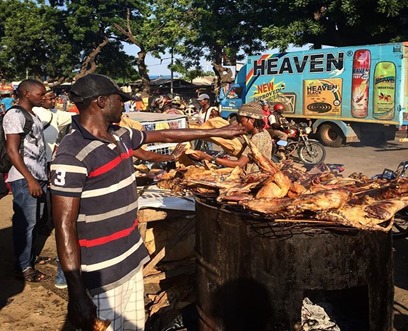
  7. Meat vending (Balango, Chanchanga)
Balango-meat-vending

A noticeable pattern in consumption among the Ghanaian Muslims, is the switch in high consumption from daylight hours to evening and night hours. As Muslims ought to abstain from food and pleasures between daybreak and sunset, the nights of Ramadan usually become hours of feast. Traditionally, some diets are recommended to Muslims to use for breaking the fast(Hadith Sunan Abi Dawud 2356). As such the Ghanaian Muslims usually set to feast on dates, fruits and beverages (Koko-- very common but not limited to the northern part of the country, Sobolo-- common in the southern part, Ice-Kenkey, etc). Increased appetite during this time is also seen of Cafe services, and Balango (main, but not exclusive in the south) or Chanchanga (common, but not exclusive in the north).
 
SOCIAL EFFECTS
Interpersonal
As the popular saying goes: “A hungry man is also an angry man”. Keeping oneself at fast (abstaining from food) during the day, and keeping vigil at night is indeed a much demanding discipline. Most Muslims during period, and especially, in the mid-day and afternoon, tend to be prone to bad temperament. They become easily irritated by normal work schedules and interpersonal interaction. Most of them become less conversant and friendly during these hours of the day. This situation if not properly managed, may negatively affect co-worker relationship and the spirit of teamwork at work places.

Organizational
In organizations or societies where Muslims are majority, organizational meetings and social gatherings with ‘no direct spiritual’ implication are often postponed. In such societies, marriage or naming ceremonies, funeral rites and other feasting celebrations are commonly rescheduled to aftermath of Ramadan. Planned celebrations such as marriage ceremonies are mostly clustered in the preceding month to Ramadan, Sha’ban (8th month on the Hijri calendar).
Another noticeable effect on social schedule is the popular tradition of the “Tafseer Period” in Ghana. This period is commonly scheduled between afternoon and evening; and Muslims gather in the Mosques or other dedicated open spaces for the purpose of reciting and listening to exegesis of the Quran. Heavy traffic is common in Muslim majority communities and could affect normal traffic flow, especially, along streets leading to Mosques. This is a highly valued and open opportunity for Muslims to learn the Quran, an inspiration derived from a hadith:
The Prophet (ď·ş) was the most generous of all the people, and he used to become more generous in Ramadan when Gabriel met him. Gabriel used to meet him every night during Ramadan to revise the Qur'an with him. Allah's Messenger (ď·ş) then used to be more generous than the fast wind.(Hadith Sahih al-Bukhari 3554
. As such, individual Muslims place premium on it that (in addition to their needs to get close to feasting spots by sunset (Hadith Sunan Abi Dawud 2353) ) it tend to affect their normal working hours (also discussed above).
Noise pollution is one of the most critical experience of living in a Muslim majority community during Ramadan in Ghana. This problem is more pronounced in the northern regions, and some communities in the Brong Ahafo and Ashanti regions. And is most unfriendly during the last ten days of Ramadan, in which the most respected Night of Laylat-ul-Qadr is honoured.
The desire adjust in order to reap the benefits of Ramadan, therefore makes the month not only affects the scheduling of social gatherings among Muslims, but also, may negatively affect organizations and the Ghanaian society in general, due to rescheduling and postponement of meetings, and traffic flows.


Moving Feast

The premium placed on charity during this month, leaves an individual Muslim buying more than is sufficient for their consumption. This they do in the hope of benefiting other folks, both the needy and the wealthy. It is also noticeable, though widely condemned, by the Imams, that some Muslims become extravagant during the period of Ramadan. This, as observed by some of the Imams leads to weight gains and waste during Ramadan. Traditionally, Muslims have been encouraged to supply food-- both breakfast and dinner-- to the mosques for the spiritual intent of gaining blessings from Allah. A special encouragement from the Prophet is that narrated by Zayd ibn Khaalid al-Juhani:
The Messenger of Allah said: "Whoever provides the food for a fasting person to break his fast with, then for him is the same reward as his (the fasting person's), without anything being diminished from the reward of the fasting person" (Jami` at-Tirmidhi 807).
Giving of gifts, generally, is not limited to food items, and so specific to Ramadan is a wider net increased in demand for and bonuses or gifts of 'Muslim' items such as the Quran, Praying mats, ablution kettles ,Rosaries, Eid-outfits among many other localized gifs. There is also increased transfer of cash among Muslims, and organizations. Generally, this is observed in the following forms:
    1. Increased charity to Mosques
    2. Increased gift giving among Muslims
    3. Increased charity donations to charity organizations and orphanages
    4. Bonuses offers by companies to customers
Mosques and Muslim charity organizations encourage Muslims to use Ramadan as a boon to increase their closeness to Allah through charity. A hadiths emphasize this when it records that
The Prophet (ď·ş) was the most generous of all the people, and he used to become more generous in Ramadan when Gabriel met him. Gabriel used to meet him every night during Ramadan to revise the Qur'an with him. Allah's Messenger (ď·ş) then used to be more generous than the fast wind (Sahih al-Bukhari 3554).

Companies also use this season of Ramadan as a boon to increase sales and win more blessings from Allah by offering catchy bonuses to customers and potential customers.

In other parts of the world, Safiya Baharune of Islamic Relief in London was attesting to this when she says "It is our busiest time of the year". A survey of Muslim e-commerce websites reveals some sweeping offers on products and services especially, for Iftar and Eid goods and services. A particular case for Ghana was a catchy advertisement in a news paper titled "Ramadan Kareem Iftar Essentials"(Daily Graphic, Wednesday, May 16, 2018); and then follows a splendor of products and discounted prices.

Marking the End of Ramadan
Following the month long Fasting period, Ramadan is climaxed by a grand celebration-- Eid-ul Fitr-- a three-day festival marking the end of the fast. There is normally a lot of activity as people visits family and friends to mark the day in grand style. It is reported that,
"Allah's Messenger would order the virgins, the mature women, the secluded and the menstruating to go out for the two Eid. As for the menstruating women, they were to stay away from the Musalla and participate in the Muslims supplications." One of them said: 'O Messenger of Allah! What if she does not have a Jilbab? He said: 'Then let her sis lend her a Jilbab.'"(Hadith Jami` at-Tirmidhi 539)
Again to this effect, Muslims are guided by a counsel from the Prophet, Muhammad, to be charitable on this day as  narrated by Ibn Umar:
Allah's Apostle enjoined the payment of one Sa' of dates or one Sa' of barley as Zakat-ul-Fitr on every Muslim slave or free, male or female, young or old, and he ordered that it be paid before the people went out to offer the 'Id prayer. (One Sa' = 3 Kilograms approx.)"(http://cmje.usc.edu/religious-texts/hadith/bukhari/025-sbt.php#002.025.579).
So the climax of Ramadan is characterized with exchange of gifts mainly food and drinks, and traditional costumes.
Consequently, the higher consumption experienced during Ramadan equates with higher economic growth. The general increased in demand for goods and services, leads to higher prices; and thus, merchants, retail stores, restaurants and cafes among others observe increased profit margins as a resulting impact of Ramadan.
However, quite worrying effects in the aftermath of Ramadan are the noticeable declined purchasing power of individual Muslims, indebtedness, weight gains and associated health defects. A more pronounced health problem among Ghanaian Muslims, in the aftermath of Ramadan is ulcer. Some health practitioners have blamed it on the excessive use of acidic goods during the Iftar period of Ramadan.


Suggestions of Solution
DEFECTS SOLUTION
Declined Productivity There is urgent need for Muslims to break their fast and for that matter prepare before hand. This often leads to shortened working hours. However, since Muslims often start the day earlier than usual, they can in goodwill, start their working hours earlier than the stipulated working hours. Again, the early part of the day, often finds Muslims fit and effective at work, coupled with early reporting hours, the Muslim workforce can turn this observed declined in productivity into higher productivity; especially, in the light of strong commitment, dedication and higher integrity, due to the hope for and the spiritual transformation that they get during Ramadan.
Weight gain, Ulcer and associate health Problems Muslims who eat a lot and uncontrollably during Ramadan should always keep in mind the negative consequence of such behavior on their health as has been proven by national medical reports. They should control their diet and follow wise counsels from doctors and other well meaning health practitioners. Contracting ulcer as a result of ones unchecked eating habit during one Ramadan period may be the bar on them to ever observe another Ramadan for the rest of their lives; since they would be medically unfit. They should always remember Allah when He commands:

.
Extravagance Some Muslims in an attempt to atone for the missed diet during fasting result to overspending on food items and gluttony, while others easily given in to impulse spending. It will do well for Muslims to listen to the Quran when it says:

And again when it warns:

Indebtedness Some Muslims either out of control or showing off tend to incur heavy debts during Ramadan. It will  do well for them to keep in mind that

. They should always keep in mind that the life of Muslim is lived to please Allah, first and foremost; and as such any acts that goes contrary to the orders of Allah, likely incur His displeasure and must therefore be shunned.
Noise PollutionSome communities in the south, especially, in the Greater Accra region, have adopted a strategy of performing the Tahajjud prayers without the use of public address(PA) system. The PAs may be used to only alert the neighborhood of the beginning of the prayers, and that’s just all. Then the prayer continues without the use of PA system. With the national call to reduce noise pollution across social and religious divides, it is only in consonant with Islamic tradition that a way such as this that does not detract any spiritual shine from Ramadan (the Tahajjud specifically) be emulated nationwide. Plus, it makes living in a Muslim majority community more friendly to both Muslims and non-Muslims during Ramadan; and for peaceful coexistence and admiration. And remember Allah when He admonishes:
           

IN CONCLUSION
The effects of Ramadan, on the economy of Ghana is seen in a two dialectical ways: decline in productivity on the one hand, and on the other hand, increased consumption of (assorted) goods and services. Given the demographics of the Muslim community in Ghana, such effects of declined productivity is likely to be marginally, and thus economically less felt.
However, the increased consumption of goods and services, is likely to have a significant effects on the Ghanaian economy, since the supply of such consumable is not limited to the Muslim demographics. For instance, the supply of fruits and other foodstuffs, drinks, and advertisements are not limited to the Muslim merchants. Interestingly in Ghana, it is that the non-Muslim merchants actively engage in the supply of Muslim 'delimited' items such as ablution kettle, and praying mats among others.
Socially, the effects are seen at the interpersonal and community/societal levels. The effects of bad temperament and delayed decision makings on the one hand, and widespread charity and donations on the other hand. Again, in the Ghanaian context, the popular observation is that there is very little if any change in organizational behavior during Ramadan. Much of the organizational  behavior is drawn from the prevailing ‘national culture’. The widespread charity is, for most part, also limited to the Muslim community in the country.


REFERENCES
http://cmje.usc.edu/religious-texts/hadith/bukhari/025-sbt.php#002.025.579
https://www.bbc.com/news/business-19281749
http://sunnah.com/bukhari/61/63
http://dailyguideafrica.com/bawumia-continues-ramadan-tour/

---END OF ARTICLE---

Article Provided by
Abdul Dayan, Safianu

Abd Dayan
Article: The Socio-Economic Impact of Ramadan on the Ghanaian Muslim Workforce
Published: 08-06-2018.
Articles Authored:
#04
Other Articles by [Author]
Editorial Board, GhMYC
Articles as at 27-05-2018
Place (from): Salaga,East Gonja District,Northern Region [GH]
Abd Dayan is a Most Active Contributing Author(MAC/GhMYCA) and a Most Active Board Member(MABM/GhMYC) of GhMYC. A graduate from the KNUST and a National Service Personnel at the Ga West Municipal Assembly, Amasaman, Greater Accra.
Connect with Abd Dayan on:
Editorial Board, GhMYC
Leave a Comment on this Post
Sunday, 27 May 2018

EVEN MORE WITH RAMADAN

First Chapter of the Quran


Praise be to Allaah, we praise Him and seek His help and forgiveness. We seek refuge with Allaah from the evil of our own selves and from our evil deeds. Whomsoever Allaah guides cannot be misled, and whomsoever He leaves astray cannot be guided. I bear witness that there is no god except Allaah alone, with no partner or associate, and I bear witness that Muhammad is His slave and Messenger.

Allaah has blessed His slaves with certain seasons of goodness, in which hasanaat (rewards
for good deeds) are multiplied, sayi’aat (bad deeds) are forgiven, people’s status is raised,
the hearts of the believers turn to their Master, those who purify themselves attain success
and those who corrupt themselves fail. Allaah has created His slaves to worship Him, as He
says

Picture2
[al-Dhaariyaat 51:56]
  (Interpretation of the meaning): “And I (Allaah) created not the jinns and humans except that they should worship Me (Alone).”

[Sheikh Muhammed Salih Al-Munajjid,70 ISSUES RELATED TO FASTING(English), ]

It is in this spirit that Allah, “azza wa jallah”, took it upon Himself to send messengers from amongst men with guidance as to what that worship of Allah is. It is guidance from Allah that we have been commanded to fast during certain part of the year. The benefit of fasting is for our own selves; it is to attain piety that will earn us the perpetual love of Allah here on earth (i.e. a kind of love that exist between a master and a slave as a result of diligent servitude and honored responsibility), as well as winning His eternal love (which is hereby used to mean an undeserved mercy of Allah that is reserved for excellent stewards). Allah says:

Picture3
[ Koran S.002:V.183]

" O you who have believed, decreed upon you is fasting as it was decreed upon those before you that you may become righteous From words of Allah it is clear that the specific antidote to the ailing spirit of man that Ramadan provide for is a boon for attaining piety. Piety is perhaps the most valuable status of servitude that any Muslim can endeavor to archive".[ Koran S.002:V.183]

It may be of benefit to consider the following parable, say one is in a race with an equally strong opponent, then in the course of the race the opponent slips or trips himself to the ground thereby offering the other competitor undue advantage of the race.
Such linkage can be drawn for Ramadan whereby as part of Allah’s boundless mercy for mankind decides to use one of His twelve months, Ramadan, as an undue advantage for mankind to, for once, triumph against their arch enemy, Shaytaan the rejected.

Piety is the most invaluable virtue that prepares man for the needed submission to the command of Allah SWA. It is in Ramadan that the deeds of the obedient servant of Allah are multiplied beyond reservation. It is in the month of Ramadan that the famous Laylatul Qadr is honored (this is a night that is very much believed to be worthy of 1000 months of worship, one that is at the peak of the impression of servitude to Allah). It is good to emphasize this, gaining the advantage offered by Laylatul Qadr alone may be likened to a monopolistic competition in which man has the absolute advantage over Shaytaan, to endeavour to reach Allah SWA with a determination and reward that is equivalent to 83yrs and more of servitude to Allah SWA. And even more is to realize that all these 83yrs of worship are not hurdled by undesired competition from Shaytaan. This surely must be a consecrated mercy from Allah SWA.

This is the month in which prayers face little or no resistance in attracting answer from Allah. Almost shattered dreams are rekindled; impossibilities are turned to possibilities; sins are forgiven,even as far as to completely turning a bulk of sins into a bulk of reward; our dead ones are blessed with such un-hoped mercy whereby thousands of perished souls, otherwise doomed to hell-fire are drawn to Jannah on no accounts of theirs; and to crown it all is the reconstruction of destiny of men to a sound footing in their journey toward ALLAH, Subhaanahu WataA’laa.

It then behooves on every Muslim to strive for the best that Ramadan can offer mankind. Perhaps the most important reason that we have to gather for an event like this—preaching(moral talk)—is to help one another to attain the most of their stewardship(servitude) to Allah,Subhaanahu WataA’laa. So the following part of this presentation will(Insha’Allah ) focus on how we can gain the most of this month of Ramadan; looking at what to do?, When to do?, as well as Where to do “what”? in order to (Insha’Allah), gain the most of this noble month of Ramadan.


GAINING THE UTMOST OF RAMADAN
Piety is the resultant effect of all the advantages or breakthroughs that can be gained out of Ramadan. Each and every one of us who hope for the most out of Ramadan must of necessity take PIETY as a goal to archive by the end of Ramadan. Why? If piety is lost out of our (Muslims) determination,  during this vantage month, it takes only a split seconds after Ramadan to lose all other benefits of Ramadan that you had gained.

Piety is that which refines the natural virtues of man to excellent servitude; it allows the servant of Allah to completely surrender his free will to the dictate of Allah AZW. So, if that transformation you get during Ramadan is lost in your life after Ramadan, one needs not a rocket scientist to tell him that Ramadan was not useful to him. Just drawing in the parable given earlier, that even after your adversary in the race has slipped or tripped to the ground then you, the other partner, having ran 1000 months ahead of him, then  he groaned from his fall and then, on staircase, catch up with you and then beat you in addition.You be the judge of your fate. Thank God that if even we lost the impact of previous Ramadan, now Allah has made possible for us to observe one more and as such we cannot afford to miss out on this opportunity. It is in the light of attaining and sustaining piety during and after the month of Ramadan that I propose the following:

Preparing oneself and one’s environment for worship, hastening to repent and turn back to Allaah, rejoicing at the onset of the month, fasting properly, having the right frame of mind and fearing Allaah when praying Taraaweeh, not feeling tired during the middle ten days of the month, seeking Laylat al-Qadr, reading the entire Qur’aan time after time, trying to weep and trying to understand what you are reading. ‘Umrah during Ramadaan is equivalent to Hajj, and charity given during this virtuous time is multiplied, and I’tikaaf (Retreat in the mosque for worship) is confirmed (as part of the Sunnah),” being generous by sharing knowledge, giving money, using one’s position of authority or physical strength to help others, and having a good attitude.”  (Ref: Sorry for a lost reference.) listening to preaching/being part of gathering where effort is being made to understand and practice Islam from Quran and Sunnah.

Contrary to these acts that may increase our chances of gaining the most out of our Ramadan, many are those who do things that can destroy one’s “hasanaa”t (good deeds) and bring sayi’aat (bad deeds) by  allowing themselves to be distracted by quiz-shows, (soap operas,) movies and sports matches, idle gatherings, hanging about in the streets with evil people and time-wasters, driving around for no purpose, and crowding the streets and sidewalks, so that the months of Tahajjud, dhikr and worship, for many people, becomes the month of sleeping in the day so as to avoid feeling hungry, thus missing their prayers and the opportunity to pray them in congregation, then spending their nights in entertainment and indulging their desires. Some people even greet the month with feelings of annoyance, thinking only of the pleasures they will miss out on.

In Ramadaan, some people travel to kaafir lands to enjoy a holiday! Even the mosques are not free from such evils as the appearance of women wearing makeup and perfume, makes the mosques even dangerous.Even the Sacred House of Allaah is not free of these ills. Some people make the month a season for begging, even though they are not in need. Some of them entertain themselves with dangerous fireworks and the like, and some of them waste their time in the markets, wandering around the shops, or sewing and following fashions. Some of them put new products and new styles in their stores during the last ten days of the month, to keep people away from earning rewards and “hasanaat”. Our ladies can help us better perfect our Eeman, by regulating Tabarru j wanton display of their bodies). We should endearvour  to avoid all these negative acts.

What if you choose to congratulate one another at the onset of Ramadan as a way of psyching up for Ramadan and extending good will to one another? Surely

there is nothing wrong with congratulating one another at the beginning of the month. The Prophet (peace and blessings of Allaah be upon him) used to tell his Companions the good news of the onset of Ramadaan, and urge them to make the most of it. Abu Hurayrah (may Allaah be pleased with him) said: “The Messenger of Allaah (peace and blessings of Allaah be upon him) said, ‘There has come to you Ramadaan, a blessed month. Allaah has made it obligatory on you to fast (this month). During it the gates of Paradise are opened and the gates of Hell are locked, and the devils are chained up. In it there is a night that is better than a thousand months, and whoever is deprived of its goodness is deprived indeed.’” (Reported by al-Nisaa'i, 4/129; Saheeh al-Targheeb, 1/490)

Instead of concerning too much about oneself  in making special arrangement for diet and its accompanied extravagance or too much concern about what trend of fashion to follow(esp.  For Eid al- Fitr), Ramadan is still a month of charitable acts where acts of charity are exponentially rewarded. How a muslim should approach charity in the month of Ramadan? A quick view of the Prophets life will illustrate this: Al-Bukhaari and Muslim reported that Ibn ‘Abbaas (may Allaah be pleased with him) said: “The Messenger of Allaah (Peace and blessings of Allaah be upon him) was the most generous of people [in doing Good], and he was most generous of all in Ramadaan when Jibreel met with him, and he used to meet him every night in Ramadaan and teach him the Qur’aan. The Messenger of Allaah (peace and blessings of Allaah be upon him) was more generous in doing good than a blowing wind.” (Reported by al-Bukhaari, al-Fath, no. 6).

How can people exchange generosity for stinginess and action for laziness, to the extent that they do not do their work properly and do not treat one another properly, and they use fasting as an excuse for all this?

Confirming the Month of Ramadan
  • The onset of Ramadaan is confirmed by the sighting of the new moon, or by the completion of thirty days of Sha’baan. Whoever sees the crescent of the new moon or hears about it from a trustworthy source is obliged to fast.
  • Using calculations to determine the onset of Ramadaan is bid’ah, because the Hadeeth of the Prophet (peace and blessings of Allaah be upon him) clearly states: “Fast when you see it (the new moon) and break your fast when you see it.” If an adult, sane, trustworthy, reliable Muslim who has good eyesight says that he has seen the crescent with his own eyes, then we should take his word for it and act accordingly (i.e., we are allowed to start fasting by virtue of his claim).
Knowing Who Is Obliged To Fast
Allah, the Exalted Says:

Picture4
[Koran:S.002/A.184]

(Interpretation of the Meaning)(Fasting) for a fixed number of days; but if any of you is ill, or on a journey, the prescribed number (should be made up) from days later. For those who can do it (with hardship), is a ransom, the feeding of one that is indigent. But he that will give more, of his own free will, it is better for him. And it is better for you that ye fast, if ye only knew."

Fasting is an obligation on every adult, sane, settled [i.e., not traveling] Muslim who is able to fast and has nothing such as “Hayd(menstruation)”  or “Nifaas (post-natal bleeding)” that legally prevent him/her from fasting.

A person is deemed to have reached adulthood when any one of the following three things occurs: emission of semen, whether in a wet dream or otherwise; growth of coarse pubic hair around the private parts; attainment of fifteen years of age(popular scholarly opinion). In the case of females, there is a fourth, namely menstruation; when a girl reaches menarche (starts her period), she is obliged to fast even if she has not yet reached the age of ten.

Children should be instructed to fast at the age of seven, if they are able to, and some scholars said that a child may be smacked at the age of ten if he does not fast, just as in the case of Salaah. (See al-Mughni, 3/90). The child will be rewarded for fasting, and the parents will be rewarded for bringing him up properly and guiding him to do good. Al-Rubay’ bint Mu’awwidh (may Allaah be pleased with her) , speaking about Ramadaan when it was made obligatory: “We used to make our children fast, and we would make them a toy made out of wool. If any one of them started to cry for food, we would give them that toy to play with until it was time to break the fast.” (al-Bukhaari, Fath, no. 1960). Some people do not think it is important to tell their children to fast; indeed, a child may be enthusiastic about fasting and may be capable of doing it, but his father or mother may tell him not to fast, out of so-called “pity” for him. They do not realize that true pity and compassion consist of making him get used to fasting. Allaah says (interpretation of the meaning): “O you who believe! Ward off from yourselves and your families a Fire (hell) whose fuel is men and stones, over which are (appointed) angels stern (and) severe, who disobey not.”(Koran: S.66:V6) (70 ISSUES RELATED TO FASTING(English) Page 9 of 26)

If a person’s reason for not fasting is obvious, such as illness, there is nothing wrong with him eating or drinking openly, but if the reason is hidden, such as menstruation, it is better to eat and drink in secret, so as not to attract accusations and the like. Once the entire disk of the sun has disappeared, the fasting person should break his fast, and not pay any attention to the red glow that remains on the horizon, because the Prophet (peace and blessings of Allaah be upon him) said: “Once night comes from there and the day disappears from there, and the sun has set, the fasting person should break his fast.” (Reported by al-Bukhaari, al-Fath, no. 1954; the issue is also mentioned in Majmoo’ al-Fataawa,25/216).

If a woman knows that her period will come tomorrow, she should still continue her attention and keep fasting; she should not break her fast until she actually sees the blood.

IT’S MY SINCERE PRAYERS THAT ALLAH BLESS YOU AND I WITH THE ABILITY TO REAP THE MOST OF THIS MONTH AS WELL AS GRANT US HIS EVERLASTING MERCY EVEN BEYOND RAMADAN, THAT WE ARE ABLE TO SUSTAIN THE BLESSINGS EVEN BEYOND RAMADAN.


ASSALAAMU ALAYKUM WARAHMATULLAH WABARAKAATUH

---END OF ARTICLE---

Article Provided by
Abdul Dayan, Safianu

Abd Dayan
Article: Even More with Ramadan
Published: 27-05-2018. First published on Facebook, June 7, 2016 and on abddayanblog, June 22, 2016
Articles Authored:
#03
Other Articles by [Author]
Editorial Board, GhMYC
Articles as at 27-05-2018
Place: [Salaga],[East Gonja District],[Northern Region] [GH]
Abd Dayan is a Most Active Contributor(MAC/GhMYC) and a Most Active Board Member(MABM/GhMYC) of GhMYC. A graduate from the KNUST and a National Service Personnel at the Ga West Municipal Assembly, Amasaman, Greater Accra.
Connect with Abd Dayan on:
Editorial Board, GhMYC
Leave a Comment on this Post

Popular Posts