Showing posts with label GhMYC Featured. Show all posts

Wednesday, 14 October 2020

DON’T JUDGE ME! NONE IS PERFECT


Don’t judge me!” has become the cliché for many Muslims. They often use this phrase (Don’t Judge Me!) to run away from advice or justify their wrongful actions. Meanwhile, some are sincere, and if given the Islamic knowledge concerning their actions, they will repent and resolve not to commit the same misdeeds. On the other hand, some will rather pull the “Don’t Judge Me!” card to justify their mistakes and follow their desires. The phrase “don’t judge me” is laced with unspoken subtext, and its utterance carries additional sentiments: “don’t think less of me”; “don’t think I am a bad person”; “don’t think you are better than me.”


Those that rebel against Islamic principles will continue to sin publicly and proudly, even after knowing the Islamic ruling of their actions. They will always display the “Don’t Judge Me!” ticket to get away with their bad deeds.

  • Not praying regularly? “Don’t Judge Me!”
  • Not fasting in the month of Ramadan? “Don’t Judge Me!”
  • Not paying the Zakat? “Don’t Judge Me!”
  • Not wearing the Hijab? “Don’t Judge Me! Faith is about the heart, not the appearance.”
  • Not going to the Masjid? “Don’t Judge Me!”
  • Aligning with Secular Liberal Feminists? “Don’t Judge Me!”
  • Engaging in Riba (Interest taking)? “Don’t Judge Me!”

Drinking alcohol and taking drugs? “Don’t Judge Me!”

It is simple; to stop being judged is to stop doing things that are judgmental.

The companions of the Prophet (SAW) would rather thank the person who had advised them to fear Allah and to correct their mistakes. On the contrary, today if a brother or sister questions our behaviour, we feel we are being judged or insulted. So, we would say, “Don’t Judge Me! You aren’t perfect, so you can’t tell me what to do.” Really? If that is the case, then Allah (SwT – Subhaanahu wa ta’aalaa) wouldn’t send down His Prophets and Messengers to come and warn us, give caution against the disobedience to Allah (SwT ) and to give glad tidings like a sincere advisor does. As human beings, by nature, we are forgetful, weak, and careless. So yes, it is true, we all make mistakes. In fact, we cannot live our lives without sins. After all, we are human beings and not Angels.

However, we need to admit the fact that we could have done something wrong; we should also be thankful that we have someone who has come to advise us and bring us closer to Allah (SwT). Remember that, the one who really loves and cares for you is the one who calls you to the course of Allah (AwJ- Azza wa Jalla, AwJ).


Why do we have to advise one another? Or why should we be bothered as to what others do?

In the glorious Qur’an, Allah (SwT) has tasked us (Muslims) to invite one another to all that is good and forbid all that Islam has forbidden. Allah (SwT) tells us to:

And let there be [arising] from you a nation inviting to [all that is] good, enjoining what is right and forbidding what is wrong, and those will be the successful. (Qur’an 03:104, trans. Sahih International, Qt03:110)

Mind you, the group of people mentioned in the above verse does not refer to any specific group of people in the Ummah (Muslimdom). Any Muslim, either male or female, could be part of this group.

We need to also understand that, providing nasiihah (sincere advice) by enjoining the good and forbidding the evil is an integral part of our religion, Islam, as Allah (Subhaanahu wa ta’aalaa) tells us in the Qur’an:

You are the best nation produced [as an example] for mankind. You enjoin what is right and forbid what is wrong… (Qur’an 03:110, trans. Sahih International, Qt03:110)

Again, the Ummah is like a whole system. If one part of it is infected (with sin), it affects and weakens the whole system. We are also worried that if we as Ummah fail to honour this duty of enjoining what is good and forbidden what is wrong or evil, then it may spread throughout the entire Ummah, and it will now deserve the cursed of Allah (SwT). We have the story of how the people of Musah (AS- alayhi al-Salam) were denied of rain because of the actions of one man (Ibn Qudaamah, Kitaab At-Tawwaabeen). We also have in the Qur’an that Allah (SwT) cursed those among the Children of Israel (the Judhists) who disbelieved because they failed to forbid one another from evil actions. Allah informs us:

Cursed were those who disbelieved among the Children of Israel by the tongue of David and of Jesus, the son of Mary. That was because they disobeyed and [habitually] transgressed. They used not to prevent one another from wrongdoing that they did. How wretched was that which they were doing. (Qur’an 5:78-9, trans. Sahih International, Qt5:78., Qt5:79.)

Abu Bakr Al-Siddiq (RA- radiy Allahu ‘anhu) narrates:

I heard Allah’s Messenger (SAW) say, “When people see something objectionable and do not change it, Allah will soon include them all in His punishment. [Al-Tirmidhi, 5142]

Prophet Muhammad (SAW) also said:

If you see a munkar (un-Islamic act), you change it with your hand; and if you cannot do that, then change it with your mouth (speak out against it); and if you cannot do [even] that, then forbid it in your heart – and that is the least of belief. [Muslim, 40 Hadith Nawawi, 34]


Some Etiquettes of Giving a Sincere Advice

Invite to the way of your Lord with wisdom and good instruction, and argue with them in a way that is best. Indeed, your Lord is most knowing of who has strayed from His way, and He is most knowing of who is [rightly] guided. (Qur’an 16:125, trans. Sahih International, Qt16:125.)

  • Purifying Intentions

Before advising a brother or sister, we must purify our intentions to advise sincerely for the sake of Allah (SwT). In our attempt to advise, our intentions must be sincerely pure with the desire to help a brother or sister and not to punish and belittle them by way of exposing their faults or ridiculing them. The Prophet (SAW) said:

Actions are but by intentions and each person will have but that which he intended. [Al-Bukhari Book 1, Hadith 1]

  • Knowledge

Having enough knowledge about the advice we intend to impart is very essential. This is because sincere advice intends to enjoin what is good and forbid what is bad. We, therefore, need enough knowledge about what we are advising else we may be actually forbidding the good, thinking we are forbidding the evil.

  • Gentleness

We must never sound harsh in our speech and actions in our attempt to advise someone. In fact, there is no better key to unlock the heart than being kind, gentle, soft, and merciful in speech and actions as the Prophet (SAW) said:

Kindness is not to be found in anything but that it adds to its beauty, and it is not withdrawn from anything but it makes it defective. [Muslim, Book 45, Hadith 100]

Allah (SwT) commanded the Prophet (SAW) to be kind, wise, and courteous when calling people to Islam. Allah said:

Invite to the way of your Lord with wisdom and good instruction, and argue with them in a way that is best. Indeed, your Lord is most knowing of who has strayed from His way, and He is most knowing of who is [rightly] guided. (Qur’an 16:125, trans. Sahih International, Qt16:125.)


  • Maintain Privacy

Al-Fudayl Ibn lyad used to say “the believer veils (the other’s wrong action) and gives sincere good counsel. The wicked person rends open (the veil concealing a fault or wrong action) and reproaches him.” [The Compendium of Knowledge and Wisdom, p. 126-127]. Imam Ibn Rajab Al-Hanbali commented on Al-Fudayl’s words saying,

It is considered an advice if it is done in private while humiliation if it is broadcasted. As for the one who exhorts him in front of people, it is merely scolding.

We all have weaknesses; therefore, giving advice should not involve exposing the personal weaknesses of people. The Prophet (SAW) said, “[For] whoever pursues the shortcomings of people, Allah will pursue theirs.” [At-Tirmidhi]

  • Avoid Being Judgmental

We should advise but not judge. We should be sincere advisors who guide towards goodness without commanding our advisees to act upon it. We should never attack the other person’s character or personality. Advising is a gentle process, which requires love, mercy, tolerance , and compassion. Therefore, if our way of advising appears harsh and judgmental, then we would end up offending the advisee instead of calling the person to goodness.

Ibn Hazm once said,

One should not advise on the condition that it must be accepted. If one goes beyond this, he will be oppressing [others] not advising, thus seeking obedience and control.

  • Give Advice as an Act of Worship, Not as a Habit

Give advice as an act of worship where you hope for reward from Allah (SwT), not as a habit where your own mistakes and misdeeds are left unattended to. We should not be part of those who give advice to others just to avoid dealing with their own un-Islamic actions. An important Sufi rule states,

He who is preoccupied with telling others to be good may find no time to be good.

  • Lead by Example

We should practice what we preach; else we will only be deceiving ourselves as well as angering Allah (SwT). Allah says in the Qur’an,

Great is hatred in the sight of Allah that you say what you do not do. (Qur’an 61:03, trans. Sahih International, Qt61:03.)

Umar ibn Abdul Aziz also said,

The one who grants advice to his brother in matters of faith and concerns himself with mending affairs of his own life has granted an excellent gift and fulfills an obligation that was due him.

Francis Bacon, one of the famous English philosophers, describes the harm of preaching what one does not practice saying,

He that gives good advice builds with one hand; he that gives good counsel and example builds with both, but he that gives good admonition and bad example builds with one hand and pulls down with the other.

Conclusion

We [as Muslims] need to always remember that Allah (SwT) describes us (Muslims) as helpers, supporters, friends, protectors of one another. Allah says,

The believers, men and women, are Auliya’ (helpers, supporters, friends, protectors) of one another. Allah also says, “So remind, if the reminder should benefit; And as of him who fears Allah, he will be reminded; He who fears [ Allah ] will be reminded. but as for the wretched one, he will turn away. But the wretched one will avoid it…” (Qur’an 87:09-11, trans. Sahih International, Qt87:09, Qt87:10, Qt87:11)

Because of this, we should be sincerely concerned about each other and help ourselves and others to prepare for life in the Hereafter. To fulfill this duty, we need to lead by example in ensuring that Islamic teachings and principles are implemented and followed correctly.

It is very important to note that, advice can only be fruitful and effective when it is backed by love and sincerity. One has to win the heart before winning one’s mind.

Lastly, let us remember that human beings are complex, different and may sometimes appear difficult. Therefore, offering sincere advice requires that we employ different strategies and etiquettes for different people depending on their unique circumstances.


May Allah guides us and forgives our trespasses.

References for further reading.

https://aljumuah.com/only-allah-can-judge-me/

http://inspiredmindsmag.com/dont-judge/

https://www.islam21c.com/islamic-thought/how-to-give-advice-without-causing-offence/

https://aboutislam.net/shariah/refine-your-heart/the-art-of-giving-advice-15-tips/

https://quran.com/


---END OF ARTICLE---


Article provided by: Mohammed Meesuna
Mohammed Meesuna is a Most Active Contributor (MAC/GhMYC) and a Most Active Board Member (MABM/GhMYC) of GhMYC .

Article Peer-Reviewed by

Abd Dayan is the proponent, Editor-in-chief; a MAC and a MABM of GhMYC.
Editorial Board, GhMYC

Saturday, 9 June 2018

The Socio-Economic Impact of Ramadan on the Ghanaian Muslim Workforce

T Central MarketRamdan-cover1Ramadaan-moon-trans

Ramadan is widely believed by Muslims to be the most sacred month of the Hijri calendar. It is the ninth month on the calendar and the one with most blessed night, the Laylatl-Qadr, for the Muslim spiritual development. Generally during the entire month of Ramadan, Islamic tradition has it that the desires of men to do evil are fettled by Allah, and thus afford the Muslim an advantage over the 'devil', especially, in the Muslim's pursuit for elixir.This once again gives an unparalleled significance to the holy month, and Muslims harness all they can to realize the utmost of this month.

Observance of Ramadan
During Ramadan, Muslims fast, abstain from pleasures and pray to become closer to God. It is also a time for families to gather and celebrate.
Observance of Ramadan means fast; of which two widely accepted implications are drawn. Firstly, abstaining from pleasures and evils, while becoming focused in some key aspects of worship(Nawafil-- Salahs, Zikr, Charity) in order to please and attain closeness with Allah. Secondly, during the daylight hours of Ramadan, Muslims may not eat, drink, smoke, or chew gum, as physical adherence to the principles of Ramadan fast. An exemptions and extension are made for the elderly, the pregnant or menstruating woman, and the sick, whom for reasons of inability or arching endurance are medically fit to fast not. As an extension, menstruating women and the temporarily ill may have to make up lost days after Ramadan (The Qur'an The Cow 2:184-5)

A typical day of fast starts with a dawn (pre-daybreak) meal, after which the abstinence from food is expected to continue until sunset. After sun set, the Muslim is expected to indulge in some prolonged prayers, literally called Taraweeh(a set of prayers observed after normal Ishai prayers in Ramadan), and or Tahajjud(a night long prayers offered in the last ten days of Ramadan). This nature of fast has a wide cascading consequences, not only on the spiritual development, but also, on the socio-economic situation of the Muslim and the society during Ramadan.

This article focuses on the socio-economic effects of Ramadan on the Ghanaian Economy, with focus on the Muslim workforce.

Socio-Economic Effects on the Ghanaian Economy
T Central Market
As alluded early on, Ramadan is associated with shorter sleeping hours and increased acts of worship both during the day and, especially, the night. This is considered a virtue, as it helps in the realization of a maximum reward in stalk for the Muslims during Ramadan.
Apart from the spiritual significance, this situation is associated with some socio-economic impacts on the society. Observations in other parts of the world reveal, decline in productivity, increased demand for consumables, bad temperament, noise pollution, and increased charitable acts. These effects could be categorized into Economic and social effects.

Economic Effects
Samer Sunnuqrot, an economist based in the Jordanian capital Amman, observed that "The productivity of workers declines in the holy month by 35-50% as a result of shorter working hours and the change in behavior during this month"(https://www.bbc.com/news/business-19281749). The desire of the Muslims for shortened sleeping hours and prolonged acts of prayers, especially, during the night, leaves the Muslim feeling lethargic later on in the day. This often results in efficiency at work place.
They often shorten working hours, especially, during the day in order to make time for afternoon or evening Tafseer (colloquially referring to gathering for the exegesis of the Quran); and to also afford ample time for Iftar (feast marking the breaking of fast daily during Ramadan).

There are cases of economic dislocation during Ramadan. In Muslim majority communities in Ghana, businesses selling food tend to suffer some setback due to loss of sales or temporal shut down of their businesses.  A close observation, reveals high mobility of Muslim labor force in the south than in the north. The consequence is that most of the individuals in the south respond to this by switching to selling of breakfast and evening meals or beverages. Where as, in the north, the same category of businesses mostly suspend business until Ramadan is over.
Again, the Muslims selling food in the south (where the non-Muslim population dominates) get some advantage since their market is mostly not limited to the Muslim demographics. Some businesses experience little or no setbacks at all in their sales during Ramadan, as their market is not only dominated by non-Muslims, but may draw completely from non-Muslim population.
In other parts of the world, some Muslim majority states may even have regulations limiting working hours and set principles for work, aside the rampant postponement of meetings and government transactions during the month of Ramadan. However, for the case of Ghana, any acts of shortening working hours are "unofficial", largely drawing from the prevailing public or organizational behavior and leniency of management and co-workers towards the fasting Muslims during Ramadan. Again, worth noting is the exemplary move by the Vice President, Dr. Mahamoud Bahumia to mark the 2018 Ramadan with a tight scheduled "Ramadan Tour" of the country, together with the Minister for Zongo Development, Abubakar Sadique Boniface,  as part of government business (http://dailyguideafrica.com/bawumia-continues-ramadan-tour/).

This temporal situation of change in attitude to work, as Samer Sunnuqrot (cited above) observed, accounts for the low productivity and performance; in addition to some cases of losses for businesses due to delayed decision and processing of government transactions.

Effect on Consumption
The economic impact of Ramadan, apart from decline in productivity, rather has a dialectical effects on consumption pattern of the Muslims.  Studies in other parts of the world finds that there is increased demand for goods especially, consumables during Ramadan. In a BBC interview, a café owner observes that "There has been a 100% increase in the number of customers during the holy month"(BBC Interview). The Ghanaian Muslims often tend to consume more and boost sales of the following during Ramadan:
  1. Fruits
  2. Porridge
  3. Sugar
  4. Dates
  5. Beverages
  6. Tea shops
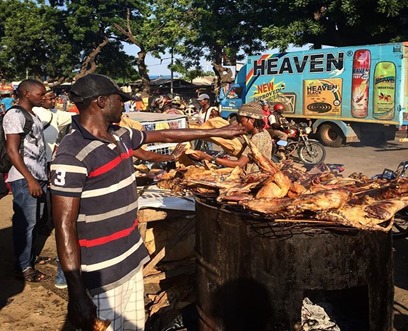
  7. Meat vending (Balango, Chanchanga)
Balango-meat-vending

A noticeable pattern in consumption among the Ghanaian Muslims, is the switch in high consumption from daylight hours to evening and night hours. As Muslims ought to abstain from food and pleasures between daybreak and sunset, the nights of Ramadan usually become hours of feast. Traditionally, some diets are recommended to Muslims to use for breaking the fast(Hadith Sunan Abi Dawud 2356). As such the Ghanaian Muslims usually set to feast on dates, fruits and beverages (Koko-- very common but not limited to the northern part of the country, Sobolo-- common in the southern part, Ice-Kenkey, etc). Increased appetite during this time is also seen of Cafe services, and Balango (main, but not exclusive in the south) or Chanchanga (common, but not exclusive in the north).
 
SOCIAL EFFECTS
Interpersonal
As the popular saying goes: “A hungry man is also an angry man”. Keeping oneself at fast (abstaining from food) during the day, and keeping vigil at night is indeed a much demanding discipline. Most Muslims during period, and especially, in the mid-day and afternoon, tend to be prone to bad temperament. They become easily irritated by normal work schedules and interpersonal interaction. Most of them become less conversant and friendly during these hours of the day. This situation if not properly managed, may negatively affect co-worker relationship and the spirit of teamwork at work places.

Organizational
In organizations or societies where Muslims are majority, organizational meetings and social gatherings with ‘no direct spiritual’ implication are often postponed. In such societies, marriage or naming ceremonies, funeral rites and other feasting celebrations are commonly rescheduled to aftermath of Ramadan. Planned celebrations such as marriage ceremonies are mostly clustered in the preceding month to Ramadan, Sha’ban (8th month on the Hijri calendar).
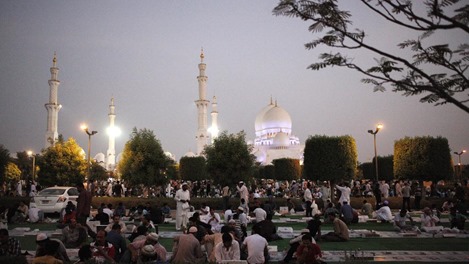
Another noticeable effect on social schedule is the popular tradition of the “Tafseer Period” in Ghana. This period is commonly scheduled between afternoon and evening; and Muslims gather in the Mosques or other dedicated open spaces for the purpose of reciting and listening to exegesis of the Quran. Heavy traffic is common in Muslim majority communities and could affect normal traffic flow, especially, along streets leading to Mosques. This is a highly valued and open opportunity for Muslims to learn the Quran, an inspiration derived from a hadith:
The Prophet (ﷺ) was the most generous of all the people, and he used to become more generous in Ramadan when Gabriel met him. Gabriel used to meet him every night during Ramadan to revise the Qur'an with him. Allah's Messenger (ﷺ) then used to be more generous than the fast wind.(Hadith Sahih al-Bukhari 3554
. As such, individual Muslims place premium on it that (in addition to their needs to get close to feasting spots by sunset (Hadith Sunan Abi Dawud 2353) ) it tend to affect their normal working hours (also discussed above).
Noise pollution is one of the most critical experience of living in a Muslim majority community during Ramadan in Ghana. This problem is more pronounced in the northern regions, and some communities in the Brong Ahafo and Ashanti regions. And is most unfriendly during the last ten days of Ramadan, in which the most respected Night of Laylat-ul-Qadr is honoured.
The desire adjust in order to reap the benefits of Ramadan, therefore makes the month not only affects the scheduling of social gatherings among Muslims, but also, may negatively affect organizations and the Ghanaian society in general, due to rescheduling and postponement of meetings, and traffic flows.


Moving Feast

The premium placed on charity during this month, leaves an individual Muslim buying more than is sufficient for their consumption. This they do in the hope of benefiting other folks, both the needy and the wealthy. It is also noticeable, though widely condemned, by the Imams, that some Muslims become extravagant during the period of Ramadan. This, as observed by some of the Imams leads to weight gains and waste during Ramadan. Traditionally, Muslims have been encouraged to supply food-- both breakfast and dinner-- to the mosques for the spiritual intent of gaining blessings from Allah. A special encouragement from the Prophet is that narrated by Zayd ibn Khaalid al-Juhani:
The Messenger of Allah said: "Whoever provides the food for a fasting person to break his fast with, then for him is the same reward as his (the fasting person's), without anything being diminished from the reward of the fasting person" (Jami` at-Tirmidhi 807).
Giving of gifts, generally, is not limited to food items, and so specific to Ramadan is a wider net increased in demand for and bonuses or gifts of 'Muslim' items such as the Quran, Praying mats, ablution kettles ,Rosaries, Eid-outfits among many other localized gifs. There is also increased transfer of cash among Muslims, and organizations. Generally, this is observed in the following forms:
    1. Increased charity to Mosques
    2. Increased gift giving among Muslims
    3. Increased charity donations to charity organizations and orphanages
    4. Bonuses offers by companies to customers
Mosques and Muslim charity organizations encourage Muslims to use Ramadan as a boon to increase their closeness to Allah through charity. A hadiths emphasize this when it records that
The Prophet (ﷺ) was the most generous of all the people, and he used to become more generous in Ramadan when Gabriel met him. Gabriel used to meet him every night during Ramadan to revise the Qur'an with him. Allah's Messenger (ﷺ) then used to be more generous than the fast wind (Sahih al-Bukhari 3554).

Companies also use this season of Ramadan as a boon to increase sales and win more blessings from Allah by offering catchy bonuses to customers and potential customers.

In other parts of the world, Safiya Baharune of Islamic Relief in London was attesting to this when she says "It is our busiest time of the year". A survey of Muslim e-commerce websites reveals some sweeping offers on products and services especially, for Iftar and Eid goods and services. A particular case for Ghana was a catchy advertisement in a news paper titled "Ramadan Kareem Iftar Essentials"(Daily Graphic, Wednesday, May 16, 2018); and then follows a splendor of products and discounted prices.

Marking the End of Ramadan
Following the month long Fasting period, Ramadan is climaxed by a grand celebration-- Eid-ul Fitr-- a three-day festival marking the end of the fast. There is normally a lot of activity as people visits family and friends to mark the day in grand style. It is reported that,
"Allah's Messenger would order the virgins, the mature women, the secluded and the menstruating to go out for the two Eid. As for the menstruating women, they were to stay away from the Musalla and participate in the Muslims supplications." One of them said: 'O Messenger of Allah! What if she does not have a Jilbab? He said: 'Then let her sis lend her a Jilbab.'"(Hadith Jami` at-Tirmidhi 539)
Again to this effect, Muslims are guided by a counsel from the Prophet, Muhammad, to be charitable on this day as  narrated by Ibn Umar:
Allah's Apostle enjoined the payment of one Sa' of dates or one Sa' of barley as Zakat-ul-Fitr on every Muslim slave or free, male or female, young or old, and he ordered that it be paid before the people went out to offer the 'Id prayer. (One Sa' = 3 Kilograms approx.)"(http://cmje.usc.edu/religious-texts/hadith/bukhari/025-sbt.php#002.025.579).
So the climax of Ramadan is characterized with exchange of gifts mainly food and drinks, and traditional costumes.
Consequently, the higher consumption experienced during Ramadan equates with higher economic growth. The general increased in demand for goods and services, leads to higher prices; and thus, merchants, retail stores, restaurants and cafes among others observe increased profit margins as a resulting impact of Ramadan.
However, quite worrying effects in the aftermath of Ramadan are the noticeable declined purchasing power of individual Muslims, indebtedness, weight gains and associated health defects. A more pronounced health problem among Ghanaian Muslims, in the aftermath of Ramadan is ulcer. Some health practitioners have blamed it on the excessive use of acidic goods during the Iftar period of Ramadan.


Suggestions of Solution
DEFECTS SOLUTION
Declined Productivity There is urgent need for Muslims to break their fast and for that matter prepare before hand. This often leads to shortened working hours. However, since Muslims often start the day earlier than usual, they can in goodwill, start their working hours earlier than the stipulated working hours. Again, the early part of the day, often finds Muslims fit and effective at work, coupled with early reporting hours, the Muslim workforce can turn this observed declined in productivity into higher productivity; especially, in the light of strong commitment, dedication and higher integrity, due to the hope for and the spiritual transformation that they get during Ramadan.
Weight gain, Ulcer and associate health Problems Muslims who eat a lot and uncontrollably during Ramadan should always keep in mind the negative consequence of such behavior on their health as has been proven by national medical reports. They should control their diet and follow wise counsels from doctors and other well meaning health practitioners. Contracting ulcer as a result of ones unchecked eating habit during one Ramadan period may be the bar on them to ever observe another Ramadan for the rest of their lives; since they would be medically unfit. They should always remember Allah when He commands:

.
Extravagance Some Muslims in an attempt to atone for the missed diet during fasting result to overspending on food items and gluttony, while others easily given in to impulse spending. It will do well for Muslims to listen to the Quran when it says:

And again when it warns:

Indebtedness Some Muslims either out of control or showing off tend to incur heavy debts during Ramadan. It will  do well for them to keep in mind that

. They should always keep in mind that the life of Muslim is lived to please Allah, first and foremost; and as such any acts that goes contrary to the orders of Allah, likely incur His displeasure and must therefore be shunned.
Noise PollutionSome communities in the south, especially, in the Greater Accra region, have adopted a strategy of performing the Tahajjud prayers without the use of public address(PA) system. The PAs may be used to only alert the neighborhood of the beginning of the prayers, and that’s just all. Then the prayer continues without the use of PA system. With the national call to reduce noise pollution across social and religious divides, it is only in consonant with Islamic tradition that a way such as this that does not detract any spiritual shine from Ramadan (the Tahajjud specifically) be emulated nationwide. Plus, it makes living in a Muslim majority community more friendly to both Muslims and non-Muslims during Ramadan; and for peaceful coexistence and admiration. And remember Allah when He admonishes:
           

IN CONCLUSION
The effects of Ramadan, on the economy of Ghana is seen in a two dialectical ways: decline in productivity on the one hand, and on the other hand, increased consumption of (assorted) goods and services. Given the demographics of the Muslim community in Ghana, such effects of declined productivity is likely to be marginally, and thus economically less felt.
However, the increased consumption of goods and services, is likely to have a significant effects on the Ghanaian economy, since the supply of such consumable is not limited to the Muslim demographics. For instance, the supply of fruits and other foodstuffs, drinks, and advertisements are not limited to the Muslim merchants. Interestingly in Ghana, it is that the non-Muslim merchants actively engage in the supply of Muslim 'delimited' items such as ablution kettle, and praying mats among others.
Socially, the effects are seen at the interpersonal and community/societal levels. The effects of bad temperament and delayed decision makings on the one hand, and widespread charity and donations on the other hand. Again, in the Ghanaian context, the popular observation is that there is very little if any change in organizational behavior during Ramadan. Much of the organizational  behavior is drawn from the prevailing ‘national culture’. The widespread charity is, for most part, also limited to the Muslim community in the country.


REFERENCES
http://cmje.usc.edu/religious-texts/hadith/bukhari/025-sbt.php#002.025.579
https://www.bbc.com/news/business-19281749
http://sunnah.com/bukhari/61/63
http://dailyguideafrica.com/bawumia-continues-ramadan-tour/

---END OF ARTICLE---

Article Provided by
Abdul Dayan, Safianu

Abd Dayan
Article: The Socio-Economic Impact of Ramadan on the Ghanaian Muslim Workforce
Published: 08-06-2018.
Articles Authored:
#04
Other Articles by [Author]
Editorial Board, GhMYC
Articles as at 27-05-2018
Place (from): Salaga,East Gonja District,Northern Region [GH]
Abd Dayan is a Most Active Contributing Author(MAC/GhMYCA) and a Most Active Board Member(MABM/GhMYC) of GhMYC. A graduate from the KNUST and a National Service Personnel at the Ga West Municipal Assembly, Amasaman, Greater Accra.
Connect with Abd Dayan on:
Editorial Board, GhMYC
Leave a Comment on this Post

Popular Posts